What do termites look like?
What do termites look like depends on which member of the colony you see. Most of a colony is workers that never leave the soil and wood, so the termites people actually notice are swarmers on a windowsill or workers spilling out of a broken mud tube. This page shows each form, the types of termites found in US homes, and the guides for checking your own house.
What do termites look like at each stage?
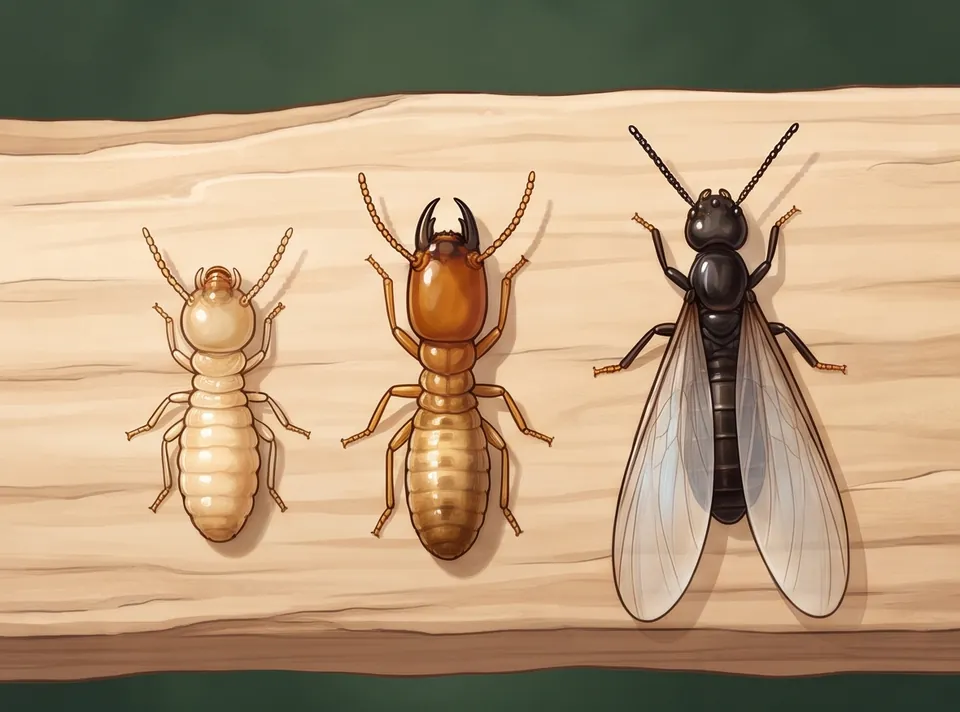
Oklahoma State adds two features that hold for every caste: termites have a wide waist with no pinch between thorax and abdomen, and their bodies are oval and tube-shaped rather than flat. Ants, the insects most often mistaken for termites, have a narrow waist; termite vs ant compares the two.
Types of termites in US homes
- Subterranean termites live in colonies in the soil and reach wood through mud tubes. Penn State calls the eastern subterranean termite present throughout Pennsylvania, and Oklahoma State finds termites in every Oklahoma county.
- Formosan termites are a subterranean species that Mississippi State notes can also nest above ground in wood kept moist by structural or plumbing leaks. Their colonies have about one soldier for every ten workers.
- Drywood termites live inside dry, sound wood without contact with soil, and push out hard pellets that pile up below the wood (UC IPM).
- Dampwood termites live in moist wood such as stumps and fallen trees, and in California are most often found in cool, humid areas along the coast (UC IPM).
Termites are not only pests. UC IPM points out that outdoors they break down woody debris and return nutrients to the soil; the problem starts when they reach wood in a house.
Sources: University of Maryland Extension, Termites; Penn State Extension, Eastern Subterranean Termites; UC Statewide IPM Program, Pest Notes: Termites; Mississippi State University Extension, Species of Termites in Mississippi; Oklahoma State University Extension, EPP-7308.